

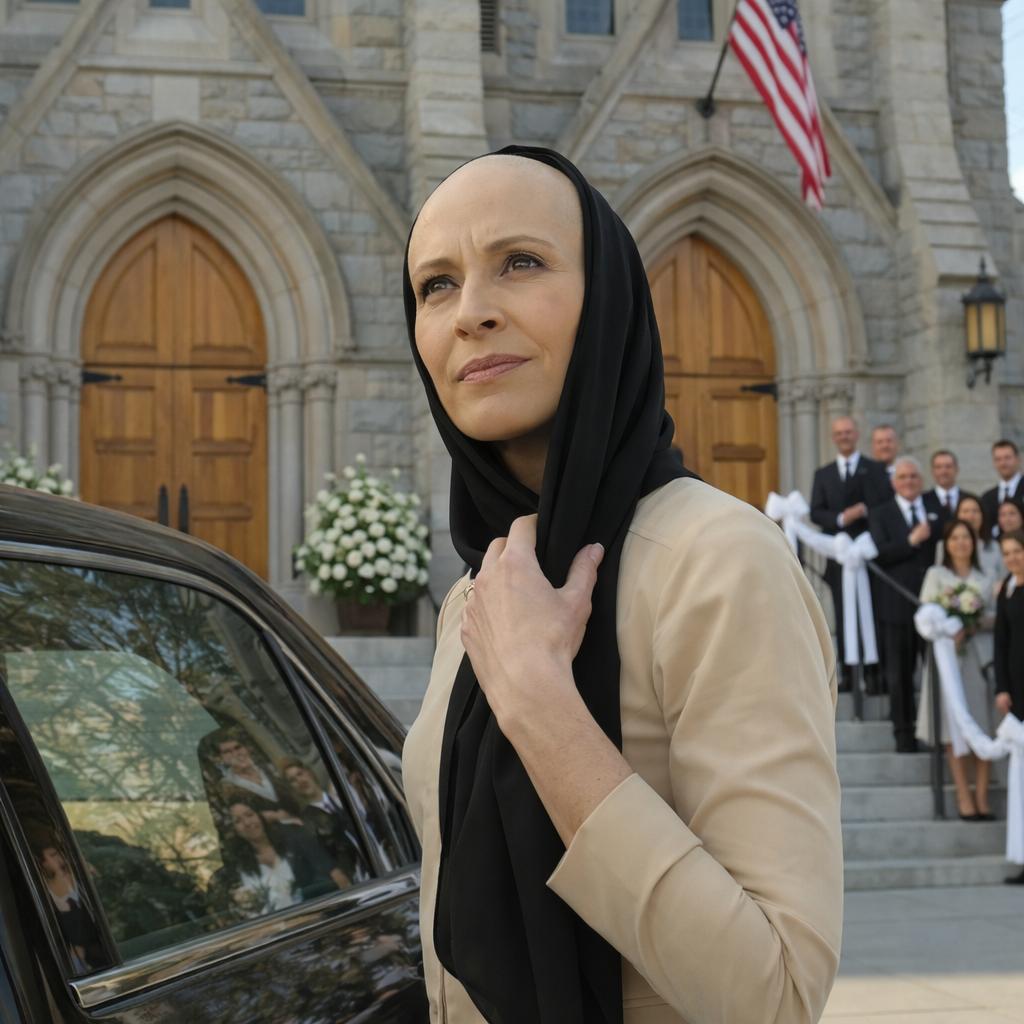
I had bought it because I had won.
Today, I would wear it again for the same reason.
The phone rang on the landline. The sound jolted me, sharp and old-fashioned, like something from a life I had outgrown.
I crossed the room and glanced at the caller ID.
Lucia.
My hair stylist for over twenty years.
My throat tightened in a way that made me almost laugh. Of course. The universe had a sense of timing.
I picked up. “Lucia, I need you. Now.”
A beat of silence, then her voice, warm and alert. “Bea? What happened?”
“I need your best wig,” I said, hating the tremor that slipped through, hating it more because it was honest. “And I need you to come to my house. Twenty minutes.”
She didn’t ask for details. She didn’t scold. She only lowered her voice and said, “I’m on my way.”
While I waited, I sat in the armchair by the window and stared out at the yard.
Snow sifted down in lazy, weightless flakes, turning the world quieter than it already was. The brick path I had walked a thousand times disappeared under a white dusting. The maple branches outside looked sketched in gray.
And without warning, my mind went where it always went when things hurt.
Back to the day Richard died.
Thirty-two years old, and I had been handed a death certificate in a hospital corridor that smelled like bleach and stale coffee. Sudden heart attack on the highway. The words had felt like a language that didn’t belong to me, something meant for other people.
I remembered Michael’s voice, twelve years old, thin with panic.
“Mom… where’s Dad?”
I had pulled him into me, held his small shaking body, and sworn a vow so deep it became part of my bones.
I will never let you go without.
For three decades, I kept that promise. I built an empire of concrete and glass and signed contracts. I walked construction sites at dawn with frost on my eyelashes. I read financial statements until the numbers burned behind my eyes. I swallowed grief and exhaustion and did it anyway.
I didn’t do it to be admired.
I did it because my son had lost his father, and I refused to let him lose his future too.
And now, on his wedding morning, I sat with a shaved head and a note meant to humiliate me.
Somewhere inside my chest, something old and tender tore slightly, and in its place, something colder settled.
The doorbell rang.
Lucia stepped inside carrying a long black case. She smelled faintly of hairspray and winter air. When she saw me, she stopped so abruptly the case tilted in her hand.
Her eyes went straight to my head.
“Oh my God,” she whispered.
I lifted my chin. “Don’t.”
The word came out softer than I intended, but it worked. Lucia shut her mouth, swallowed the pity, and set her case down with the calm of a woman who understands that dignity is sometimes a kind of medicine.
“Sit,” she said gently.
I sat at my vanity while she unpacked wigs with the care of someone handling fragile art. She tried a few, pulling them close, measuring, murmuring to herself. The movements were familiar, almost soothing, her fingers brisk and confident.
When she finally placed one on my head, I felt the soft weight settle against my scalp. Cool fibers brushing the raw skin. A line of relief moved through me like warmth.
Lucia adjusted the hairline, brushed it, parted it. She stepped back, eyes narrowed, and said, “Turn.”
I turned.
She fixed the sides, tapped the top, and nodded once. “This one.”
When she held up the mirror, I stared at myself again.
Silver hair, thick and elegant, falling in the same way mine always had. Not dramatic, not theatrical. Realistic. A version of myself I could live inside without feeling like an imposter.
My lips parted slightly. The sight made my throat sting, and for a second I had to blink hard.
Lucia watched me with something close to fury on my behalf. “Who did this?”
I met her eyes in the mirror. “Someone who thinks I’m disposable.”
Lucia’s jaw tightened. She reached into her kit and dabbed something soothing along my irritated scalp at the edges. The cool gel eased the burn a fraction.
Then she leaned close and whispered, “You’re not.”
I pressed my lips together and nodded. Words felt too risky.
When she was done, I slipped an envelope into her hand, heavier than her usual fee, because I needed her to understand what her discretion was worth.
Lucia glanced down, then back up at me. Her eyes softened.
“You call me if you need anything today,” she said.
“I will,” I replied, and I meant it.
After she left, I stood alone in the bedroom, dressed now in navy silk, my shoes polished, my makeup controlled and clean.
I opened my purse and slid in a small voice recorder.
The motion was instinct more than plan. I had learned long ago that when power shifts, people lie. They lie quickly, convincingly, and often without shame. Proof was the only language that mattered when someone tried to rewrite the story.
The clock read 10:00 a.m.
Three hours until St. Andrew’s.
I wrapped a cashmere scarf around my neck, the one Michael had given me years ago. The fabric was still soft, still smelled faintly like his cologne when I pressed it near my face. For a beat, the memory almost broke me.
Then I remembered the note on my pillow.
I picked up my coat and walked out into the cold.
The wind slapped my cheeks the moment I stepped outside. It was a clean Boston cold, bracing and unapologetic. Snow creaked underfoot. The black town car waited in the circular driveway, engine idling.
My driver opened the door and glanced at me in the rearview mirror with the polite interest of someone who had known me for years and sensed something was off.
I shook my head slightly.
Not today.
I slid into the back seat and let the door close behind me, shutting out the house, the bedroom, the mirror.
On the drive, Boston moved past the window in small scenes of ordinary life. Couples at crosswalks, a man balancing coffee cups, a woman tugging her child’s hood up against the wind. People living their mornings without knowing anything about the private war beginning in my chest.
I watched them and wondered how many people had been betrayed quietly, in ways no one saw. How many had sat in expensive homes with cheap humiliation pinned to their pillows.
The car turned toward the hill where St. Andrew’s stood. Its stone façade rose gray and solemn against the winter sky. Stained glass glowed faintly from inside, a promise of warmth and ceremony.
When we stopped, I pressed a hand to my chest and felt something unexpected.
Not panic.
Calm.
A calm built from decisions already made.
Inside, the church smelled of candles and old wood. Staff moved briskly, arranging white flowers, checking pew ribbons. The echo of footsteps traveled up into the vaulted ceiling. A choir rehearsed softly, their voices floating like smoke.
I took my seat near the front on the groom’s side and folded my hands in my lap, the way I had practiced a thousand times in public settings when my emotions had to behave.
My scalp still burned under the wig.
But beneath the burn, something else was alive.
Anger, yes.
But also clarity.
I sat with my gaze lifted toward the stained glass, and my mind slipped, as it always did in churches, into memory.
The small house outside Boston. The nights I stayed awake doing paperwork while Michael slept. The mornings I pretended I’d already eaten so he could have the last piece of toast. The first duplex I bought, my hand trembling as I signed.
Brick by brick. Deal by deal. A life built on grit.
Michael grew up seeing outcomes without understanding cost. Tuition paid. Car keys handed over. Condo down payment written like it was nothing. He asked, and I gave, believing love could cover the gaps that grief had left.
Then he brought Sabrina into our orbit.
Beautiful. Smooth. Charming in public. The kind of woman who knew how to tilt her head and laugh at a man’s joke as if it was the cleverest thing she’d ever heard.
But when she looked at me, there was always calculation. Not warmth. Not curiosity. Scrutiny.
At dinners, she made her comments lightly, as if she was doing me a favor.
“Mrs. Langford, don’t you think that color ages you?”
“I love that you don’t care what people think.”
Each line delivered with a smile sharp enough to cut.
Michael laughed along like it was harmless.
I had swallowed it because swallowing had become my specialty. Swallow the sting, swallow the fear of losing him, swallow my own pride because being a mother felt like it required endless forgiveness.
Aby zobaczyć pełną instrukcję gotowania, przejdź na następną stronę lub kliknij przycisk Otwórz (>) i nie zapomnij PODZIELIĆ SIĘ nią ze znajomymi na Facebooku.