

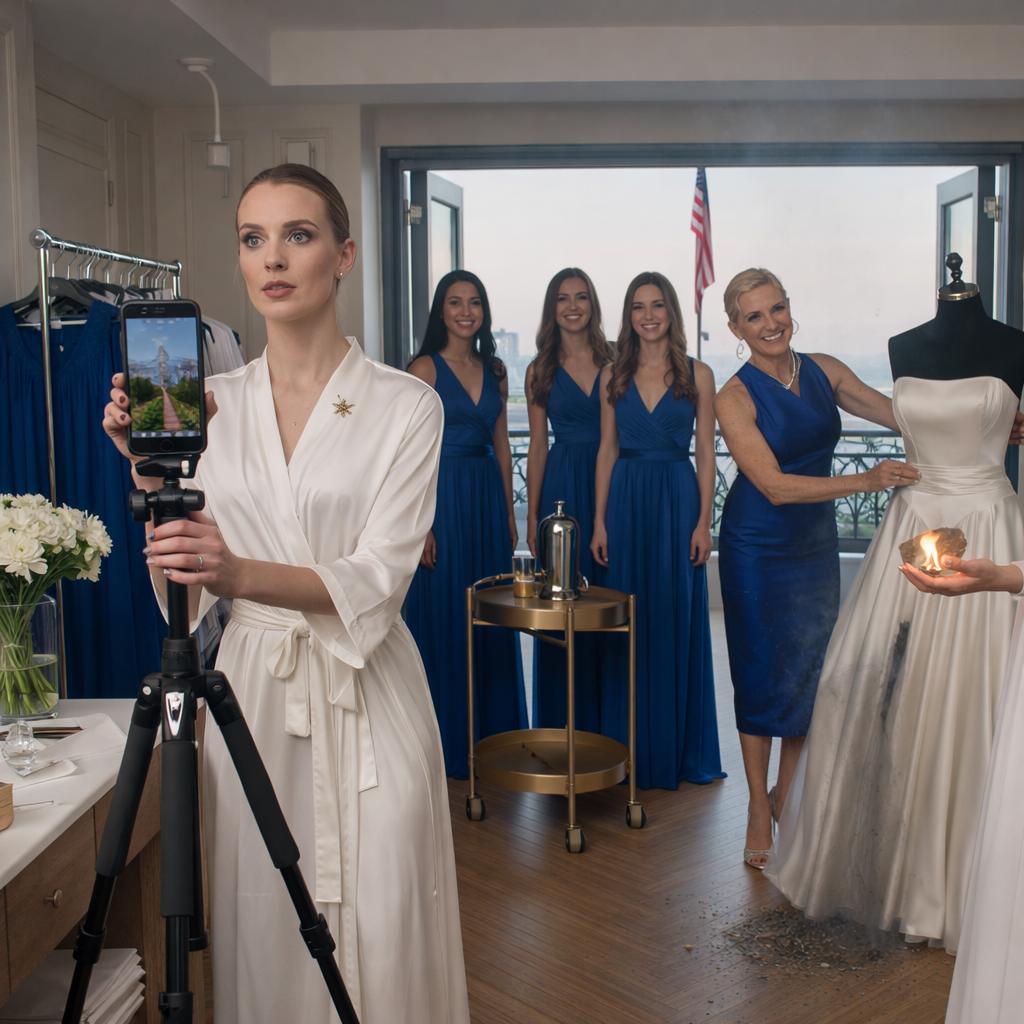
“I am sorry,” he said, voice rough. “I am so sorry.”
“You did not light the match,” I replied. My voice was steady. I could feel the adrenaline buzzing under my skin, but it was contained, directed. “Look at me, Jason. Are you still here?”
He swallowed hard and nodded. “I am here.”
Richard Wilson took one slow step into the room. He looked like a man who had just watched his entire world tilt on its axis. His suit was perfect, but his face was not. There was shame in his eyes, sharp and unmistakable.
“Captain Harvey,” he said, and there was weight in the way he addressed me. “I am sorry. This will be handled. The ceremony can still proceed if you want it to.”
I glanced at the wall clock.
We were already behind schedule.
My bridesmaids looked at me like I was the only person in the room with a map.
I inhaled once, deep and deliberate, then made a decision that snapped everything into focus.
“We proceed,” I said.
Jason’s eyes flashed with relief so intense it almost looked like pain.
I turned to Jessica Reyes. “Jess, help the bridesmaids clear this room. We need airflow and we need a clean floor. The fire is out, but the smoke will linger.”
Jessica nodded. “Yes, ma’am.”
I turned to Jason. “You are on guest control. You find the wedding coordinator and keep everyone calm. Tell them we had a wardrobe delay and the bride is still coming. You do not let anyone feed this drama.”
“I understand,” he said, and he moved immediately.
Richard stepped closer. “What do you need?” he asked.
I met his eyes. “A dress,” I said.
Richard’s expression tightened. “We can solve that.”
One of my bridesmaids, Melody, already had her phone out. She worked in fashion. She knew the right people. She looked at me and waited for permission.
“Call your boutique contact,” I told her. “We need a sample gown. Ivory or white. Clean lines. Something that fits fast. We need it brought here as quickly as possible.”
Melody was already dialing. “On it.”
Richard pulled his own phone out and made a call that sounded like a CEO issuing a directive, not a man begging for a miracle. “Send the driver to Michelle Keane’s boutique,” he said. “Yes. Now. I want him waiting at the door.”
The room shifted.
Shock turned into motion.
My bridesmaids opened windows. Someone brought in a small fan. Someone wiped soot from the vanity surface. Jessica handled it all with calm precision, directing people without raising her voice.
I did not look at the ashes again. Not because it did not hurt. Because I did not have time to fall apart. That part could come later. My job was to move forward.
I glanced at the phone still propped on the vanity. The livestream was still running.
My unit in Germany had seen everything. Jason’s family in Florida had seen everything. People in the courtyard were already watching clips. Someone somewhere was already recording the recording.
I picked the phone up and looked into the lens.
“To everyone watching,” I said clearly, “thank you for staying with us. The ceremony is delayed, not canceled. We are still getting married.”
The speaker erupted with cheers and voices. I heard my sergeant again, loud and steady.
“Captain, we are with you.”
I nodded once. “I know.”
Then I ended the livestream.
Not because I was embarrassed. Because the next part needed to be ours, not the internet’s.
—
The seventeen minutes it took for Richard’s driver to return felt longer than deployments.
Time stretched the way it did right before something critical. Every second was audible. Every breath felt counted.
Then the door opened and a man in a suit hurried in with a long garment bag like he was carrying a fragile relic.
Melody unzipped it.
The dress inside was not lace. Not beaded. Not delicate.
It was ivory crepe with clean lines and a strong silhouette. Minimal. Elegant. Powerful. It looked like confidence in fabric form.
It did not whisper fairy tale.
It said, this woman cannot be pushed.
My bridesmaids moved fast. Jessica and Melody helped me step into it, the fabric cool against my skin. It fit better than it had any right to. Melody made two small adjustments with a needle and thread she pulled from her bag like she had been waiting her whole life to do emergency alterations under pressure.
When I looked in the mirror, I barely recognized myself.
Not because I looked like a stranger.
Because I looked like the version of me that did not negotiate with contempt.
Jason reappeared at the door, eyes scanning me, relief hitting his face in a wave.
“You look incredible,” he said.
“Good,” I replied. “Let’s go.”
—
My father was waiting at the entrance to the courtyard in his firefighter dress uniform.
He took one look at me and his eyes filled.
He did not ask what happened. He did not demand details. He just stepped forward and took my arm, grip steady and familiar.
“Ready?” he asked quietly.
“Yes,” I said.
The music started.
We stepped into the courtyard.
And the entire crowd stood.
Not slowly. Not politely. Everyone rose at once, as if they had been waiting for a signal.
Then the applause hit.
Loud. Rolling. Unmistakable.
It was not the polite clap of wedding guests. It was the roar of people who had witnessed something ugly and wanted to drown it out with something better.
As we walked down the aisle, I saw faces blurred by tears. I saw Jason’s coworkers standing straighter than I expected. I saw my friends beaming like they were watching justice in motion.
Then I saw something that tightened my throat.
In the second row, an older man with service ribbons on his chest raised his hand in a crisp military salute.
Then another.
Then another.
Veterans. Active duty. People who recognized what Margaret had tried to do and what I had refused to become.
My vision blurred. I did not wipe the tears away.
I let them fall. They were not weakness. They were release.
At the altar, Jason took my hands.
His eyes held mine like he was grounding himself in the fact that I was real and still here.
The officiant, a retired Army chaplain, looked at us for a moment, then spoke without his prepared notes.
“Today,” he said, “we are not only witnessing a marriage. We are witnessing a choice. A commitment made under pressure. In the military, the person you trust through chaos is your battle buddy. Today, Jason and Katie are choosing to be battle buddies for life.”
When it came time for vows, Jason did not recite anything traditional.
He spoke plainly.
“Katie,” he said, voice steady, “I promise that you will never stand alone in a fight again. I promise I will not compromise you to make someone else comfortable. I promise I will choose you, even when it costs me.”
My chest tightened. My hands held his harder.
When I spoke, I did not perform softness. I spoke truth.
“Jason,” I said, “I promise you will never have to choose between peace and integrity again. I promise I will protect what we build. I promise I will love you without letting anyone else define us.”
The chaplain pronounced us husband and wife.
Jason kissed me like he had been holding his breath for hours and finally remembered how to breathe.
The applause was thunderous.
We walked back down the aisle together, and I knew one thing with absolute certainty.
Margaret had lit a fire to end this.
All she had done was prove what we were made of.
—
The reception felt like a different world.
The air buzzed with joy, but something else ran underneath it now. A current of consequence.
People kept checking their phones. Not because they were bored. Because the clip had moved faster than anyone could control. Margaret’s Zippo. The burning silk. Her words. Jason running. The veterans saluting.
It was already everywhere in our community.
Margaret’s social circle, the women who usually moved through events like they owned oxygen, clustered awkwardly near the far wall. They looked uncertain. They looked like people who had come expecting prestige and were leaving with discomfort.
One of them, a woman with diamonds in her ears, approached me and tried to smile as if the day had simply been dramatic.
“Margaret gets overwhelmed,” she said lightly. “It was unfortunate.”
I looked her in the eye. “That was not overwhelm,” I said calmly. “That was intent.”
Her smile faltered. She backed away quickly, like she had touched heat.
Richard Wilson did not apologize quietly all night. He did the opposite. He introduced me to guests with pride.
“This is my daughter,” he said more than once. “Captain Harvey. Toughest person in this family.”
Jason’s hand always found mine. Every time.
During the toasts, Richard stood and raised his glass.
“To Jason and Katie,” he said. “Thank you for reminding us what matters.”
Then he added, very deliberately, “The Wilson Family Foundation will be shifting its focus in the coming year.”
People murmured. Not because they cared about foundations, but because they understood what it meant.
Margaret’s pet projects were done.
Her influence was done.
The center of power had moved.
My bridesmaids created a guest board on a whim, pinning notes and messages instead of signatures. Guests wrote things like:
Honor cannot be bought.
Thank you for showing strength.
You did not bend.
Your father must be proud.
I read those notes late that night when the room finally quieted and my adrenaline started to fade.
They mattered more than the gifts.
—
Near the end of the night, Jason showed me a message from his father. Richard had spoken to Margaret after she was escorted home.
“She is not sorry for burning the dress,” Richard’s message said. “She is sorry she was seen.”
Jason’s shoulders sagged when he read it. He looked at me with the weariness of someone who had spent years managing a parent’s moods.
“Do you think we can ever forgive her?” he asked.
We stepped outside into the hotel garden where the air was cool and clean, and the fountain’s murmur softened the silence between us.
“We can forgive,” I said carefully. “Forgiveness is for us. It keeps her from living in our heads. But trust is separate. Trust has to be earned. Boundaries are not punishment. They are protection.”
Jason nodded slowly, as if hearing language he had needed his whole life.
Then he reached into his jacket pocket and pulled out a small velvet box.
Inside was my bronze star.
Cleaned. Polished. Warm from being close to his body.
He placed it in my palm and closed my fingers around it.
“My mother called it cheap,” he said. “She was wrong. This represents who you are. I am proud to be your husband.”
The last sting of Margaret’s words dissolved in that moment, not because her cruelty was erased, but because it no longer had power.
We stood shoulder to shoulder under the night sky, looking out over Cleveland’s skyline.
We were married.
We were intact.
And we were not afraid.
—
Three months later, we were back in the same hotel ballroom for the Wilson Family Foundation gala.
Only it did not feel like Margaret’s event anymore.
Richard took the stage and introduced a new initiative. A new mission. A new logo on the screen behind him.
A phoenix, rising from flame.
“The Phoenix Project,” Richard announced, “will support women veterans and military families transitioning into civilian life, with grants for education, housing, and small business development.”
Applause filled the room, real and sustained. Not social applause. Purpose applause.
I stood beside Jason, now a board member, and felt something settle into place.
Margaret had tried to destroy my future with fire.
Instead, that fire became a symbol of what we built.
Later that evening, a hotel staff member delivered a cream envelope to Jason.
Inside was a simple card in five handwritten words.
I have started the therapy.
Jason read it, then looked at me.
“It is a beginning,” I said. “Nothing more. Nothing less.”
He nodded and folded the card into his pocket.
Weszliśmy na ten sam balkon, na którym staliśmy w noc poślubną.
Miasto lśniło poniżej.
Jason objął mnie w pasie. "Czy kiedykolwiek myślałaś, że jedna spalona sukienka doprowadzi do tego wszystkiego?"
Spojrzałem na panoramę, potem na brązową gwiazdę w mojej dłoni, której ciężar był znajomy i stały.
"Ogień tylko spalił to, co nigdy nie miało trwać," powiedziałem. "Wszystko prawdziwe zostało."
I w ciszy, która nastąpiła, poczułem to.
To nie bajka.
Nie jest to idealne zakończenie.
Życie zbudowane na czymś silniejszym niż aprobata.
Życie, które już przetrwało swój pierwszy poważny test.
Aby zobaczyć pełną instrukcję gotowania, przejdź na następną stronę lub kliknij przycisk Otwórz (>) i nie zapomnij PODZIELIĆ SIĘ nią ze znajomymi na Facebooku.