

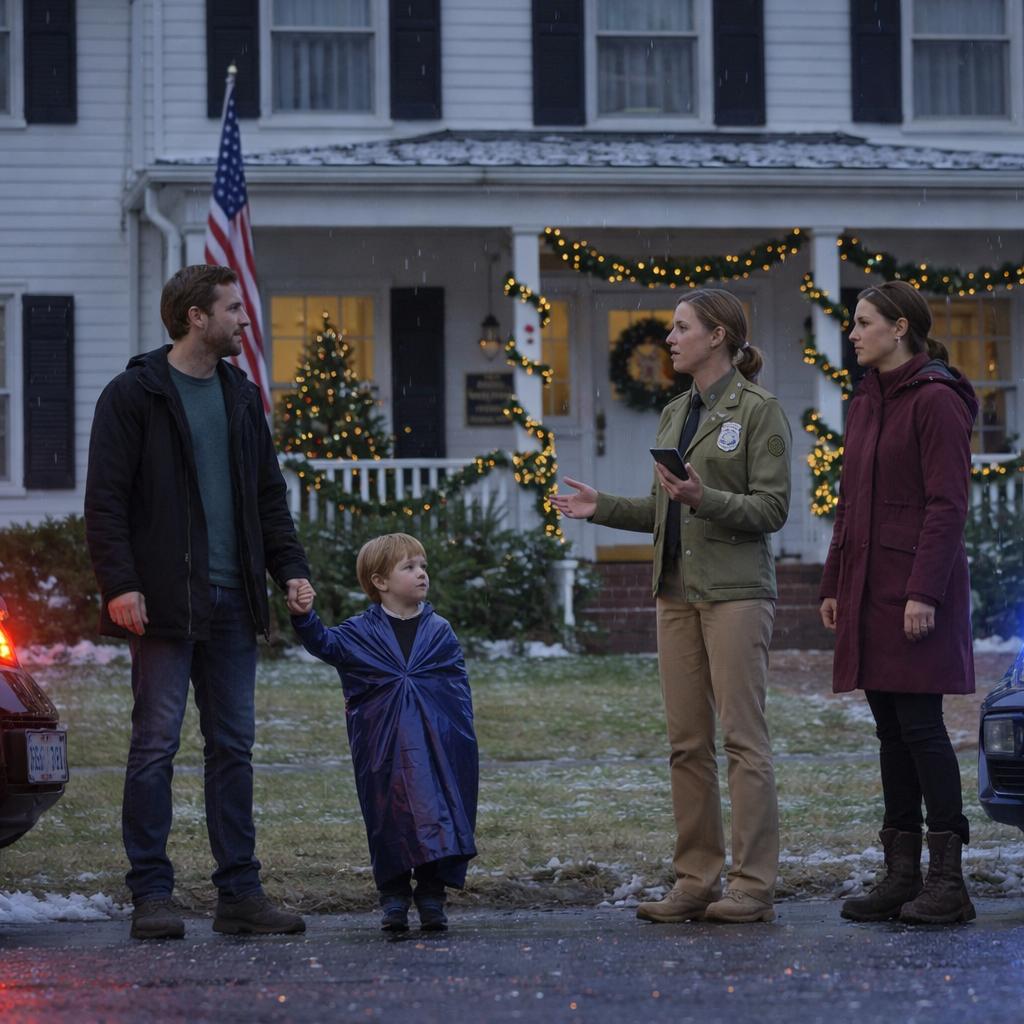
"Gdzie jest moja żona?" William zażądał nagle, pytanie paliło go w środku. "Gdzie jest Marsha?"
Twarz policjanta się napięła. "Jednostki są teraz przy rezydencji Meltonów, proszę pana."
Świat wydawał się nierealny, gdy William wyszedł na zewnątrz, prowadzony przez funkcjonariuszy. Nocne powietrze uderzyło go w twarz, zimne i ostre, i przez chwilę pomagało mu oddychać.
Dom Sue Melton stał obok, światło na werandzie świeciło, a wokół niego stały radiowozy. Trawnik, który był tak zadbany, teraz wyglądał jak scena dla czegoś brzydkiego.
Marsha stood on the porch.
Her hair was slightly mussed, her coat open. Her face, instead of fear or concern, held something else. Fury. Shock. And beneath it, something calculating that made William’s skin crawl.
When she saw William, she rushed down the steps.
“What did you do?” she screamed, her voice slicing through the night. “What did you tell him to do?”
William stared at her, stunned by the accusation. Not “Is Owen okay?” Not “Where is he?” Not “What happened?” Only blame, flung at William like a weapon.
“You think this is about me?” William’s voice shook. “You think this is about what I told him?”
Marsha’s eyes flashed. “He attacked my mother!”
“Your mother locked our son in a shed,” William said, and the words felt like glass in his mouth. “What was she doing to him?”
Marsha’s mouth opened, then closed. A fraction of hesitation, as if she had to choose which lie to wear.
Detective Alberta Stark stepped in then, a woman with tired eyes and a steady presence. She moved between William and Marsha with the ease of someone who had stepped between worse things before.
“Mrs. Edwards,” Stark said evenly, “we need you to come with us. We have questions.”
“I’m not going anywhere,” Marsha snapped. “I’m going to the hospital. My mother is hurt.”
Detective Stark’s expression didn’t change. “Your mother is being transported to Hartford Hospital. Severe facial lacerations. Possible skull fracture. You will have an opportunity to get information, but right now, you’re going to answer questions about why your five-year-old son was locked in a shed.”
Marsha’s face tightened. For a split second, the fury slipped and something else showed through. Not grief. Not fear. Calculation.
“I want a lawyer,” Marsha said abruptly.
Detective Stark nodded once, a small, controlled movement. “You can have one.”
An officer guided Marsha toward a patrol car.
As she passed William, Marsha leaned in close, voice low enough that only he could hear. Her breath smelled faintly of wine.
“You’ll regret this,” she whispered. “You have no idea what you’ve done.”
William’s skin went cold. He watched her get into the car, watched the door shut, watched the red and blue lights wash over her face in flashes, making her look like a stranger.
He turned back toward Owen, who was being loaded into the ambulance. The paramedic kept her voice soft, her hands gentle, like she understood that Owen’s nervous system was still trapped in terror.
William climbed into the ambulance with them. He sat close enough that Owen could see him, close enough that Owen’s small hand found his and clung tight.
The ride to the hospital was a blur of sirens and fluorescent light. Owen’s breathing came in shallow bursts. Every time a door slammed or a voice rose, he flinched.
William kept one hand on Owen’s blanket-covered shoulder, as if touch could anchor him back to safety.
At the hospital, the smell of antiseptic hit William like a wave. Bright lights, white walls, the constant hum of machines. Nurses moved quickly, their shoes squeaking on polished floors.
Owen was admitted for observation. Doctors examined him, asking gentle questions, scanning his body for injuries.
William stood at the edge of the bed, his heart lodged in his throat, watching every movement of every gloved hand.
A doctor finally looked up and spoke quietly. “He’s not bleeding,” she said. “No wounds that explain the amount of blood. We’ll run tests, but right now it appears the blood is not his.”
William exhaled a shaky breath he didn’t realize he’d been holding. Relief surged, sharp and dizzying, but it didn’t last. Not when he remembered the video. Not when he remembered Owen’s words.
I fought back.
Oczy Owena co chwilę zerkały w stronę drzwi, jakby spodziewał się, że ktoś wejdzie i go odciągnie. Nawet w szpitalu, otoczony ludźmi, którzy chcieli pomóc, nie potrafił się rozluźnić. Jego ciało nie wierzyło w bezpieczeństwo.
Później, tuż przed północą, w drzwiach pojawiła się znajoma twarz.
Dr Isaac Dicki.
William znał go z konferencji zawodowych, paneli dyskusyjnych i cichych rozmów na korytarzach o badaniach nad traumą. Widząc go tutaj, w tym kontekście, żołądek Williama ścisnął się.
Dicki wszedł do pokoju, z ponurym wyrazem twarzy.
"William," powiedział cicho.
Głos Williama zabrzmiał ochryple. "Poprosili o psychologa."
Dicki skinął głową. Jego wzrok na chwilę powędrował do Owena, który w końcu zapadł w lekki, niespokojny sen. Dłoń Owena wciąż kurczowo trzymała się palca Williama jak lina ratunkowa.
"Muszę z tobą porozmawiać," powiedział Dicki.
Gardło Williama się zacisnęło. "Czy on... Czy on jest w porządku?"
Wyraz twarzy Dickiego złagodniał, ale tylko nieznacznie. "Jego parametry życiowe są stabilne," powiedział. "Ale badanie fizykalne wykazało pewne obawy."
Serce Williama zdawało się zatrzymać. "Jakie obawy?"
Dicki obniżył głos. "Stare siniaki. Na różnych etapach gojenia. Na plecach miał jakieś blizny, które odpowiadały uderzeniom paskiem lub czymś podobnym. I markery behawioralne sugerujące długotrwałe przemoc psychiczną."
William patrzył na niego, nie rozumiejąc, a potem zbyt szybko rozumiejąc.
Stare siniaki.
Aby zobaczyć pełną instrukcję gotowania, przejdź na następną stronę lub kliknij przycisk Otwórz (>) i nie zapomnij PODZIELIĆ SIĘ nią ze znajomymi na Facebooku.