

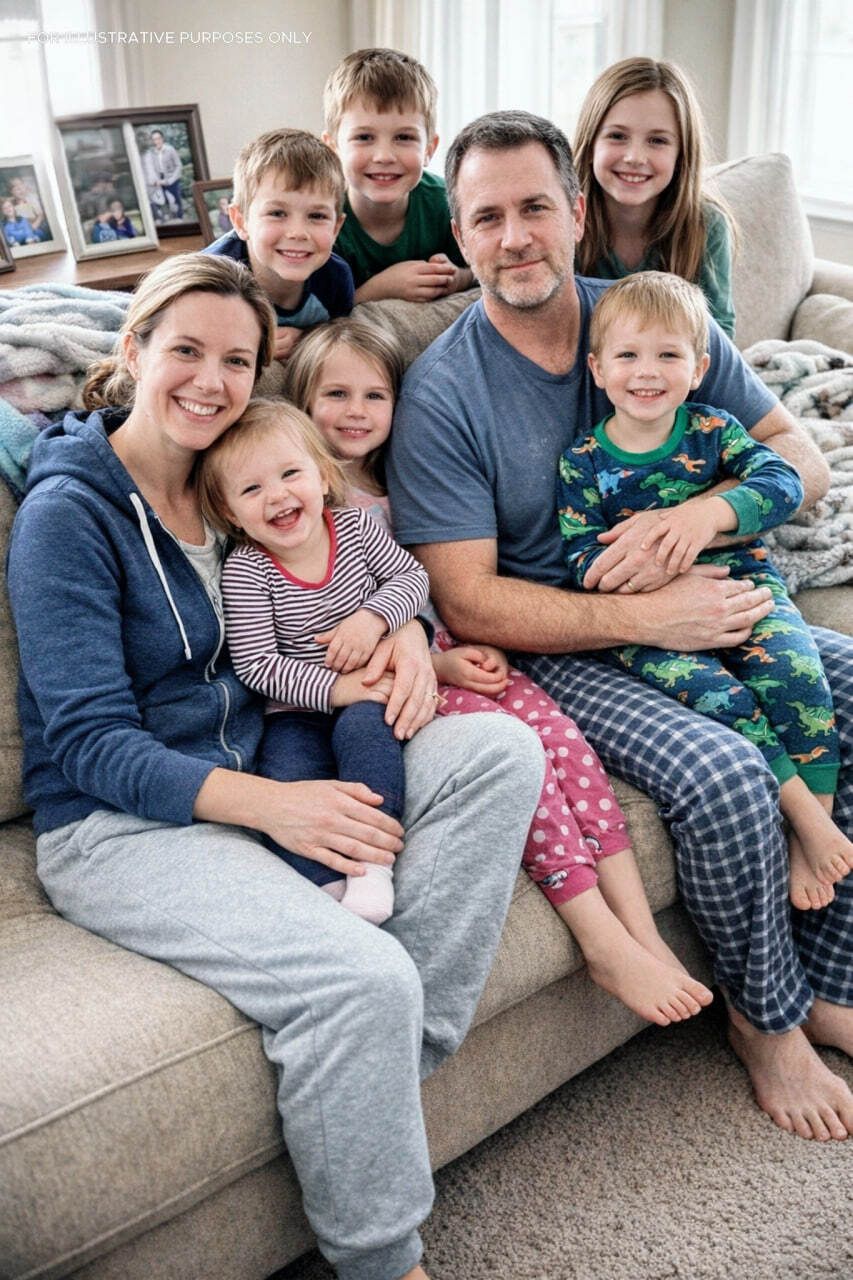
The kids started sleeping through the night more often. They began to laugh again, real laughter, not the forced kind. They grew into the rhythms of our home. They started calling me Mom, sometimes quietly, sometimes without thinking, and every time it happened it made my throat tighten.
We built new traditions. We celebrated birthdays with their favorite desserts. We hung photos of Rachel and Daniel where the kids could see them, because pretending the past did not exist only makes it heavier. We told stories about their parents at the dinner table, the funny ones and the tender ones. We made room for their grief without letting it swallow them whole.
Years passed. Life stabilized.
I started believing, finally, that the storm had moved on.
Then one quiet afternoon, when the house was unusually still and I was home alone, someone knocked at my front door.
Not a casual tap. A firm, deliberate knock.
When I opened it, a woman stood on my porch who did not look like a neighbor or a friend. She was well dressed and composed, the kind of person who seemed used to being listened to. Her expression was controlled, but there was something sharp in her eyes, like she had rehearsed this moment.
“You’re Rachel’s friend,” she said. It was not a question. “The one who adopted her children.”
My heart stuttered. “Yes,” I managed.
“I knew her,” the woman continued. “And you deserve to know the truth. I’ve been trying to find you for a long time.”
The air felt tighter around me. “What truth?”
She held out an envelope.
“She wasn’t who she said she was,” the woman said quietly.
Before I could ask another question, she turned and walked away. Just like that, leaving me standing there with an envelope in my hand and a terrible feeling spreading through my chest.
I closed the door and stared at what she had given me.
The handwriting on the envelope was familiar.
Rachel’s.
My knees went weak. I sat down at the kitchen table before I opened it, because something in me knew this was going to change how I saw the past.
Inside was a letter.
And as I read, I felt like the ground under my life shifted.
Rachel wrote about a part of her story she had never shared with me. A life before the one I knew. A family with wealth and influence, but also control and expectations that suffocated her. She described growing up in a world where appearances mattered more than peace. Where choices were made for her, not with her. Where love came with strings attached.
She wrote that she and Daniel had left that life behind. They changed their names. They disappeared into an ordinary community on purpose. They started over quietly and built the warm, messy home I had always believed was simply their natural happiness.
For years, it worked.
Until it did not.
Rachel explained that Daniel’s fatal traffic incident had not been as random as everyone assumed. She did not go into dramatic details in the letter, but her meaning was clear enough. There were people from her past who had not accepted her leaving. People who had resources. People who believed they could pull her back into that world, or punish her for escaping it.
And then, when she became ill, she understood her time was short in more ways than one. She was not only facing the end of her life. She was racing against the fear that someone might come for her children.
That is when the letter reached its most painful truth.
Rachel had chosen me.
Not because I was a convenient option. Not because she had nowhere else to turn. She chose me because she believed I was the safest person in the world for her children.
She wrote that I was ordinary in a way that protected us. That I was not connected to her old life. That I would not be visible to the people she feared. She wrote that I loved her children without conditions, and that love was the only thing she trusted completely.
She also wrote that she had prepared everything. Legal protections. Paperwork. Plans that would make it difficult for anyone to challenge the adoption or disrupt the children’s lives. She had built a quiet wall around them, not with drama, but with careful planning.
By the time I reached the end of the letter, I was crying so hard I could barely see the words.
It was not betrayal.
It was trust.
Rachel had trusted me with the most precious thing she had left.
That night, I tucked all six children into bed, one after another, kissing foreheads and smoothing blankets. I did not tell them what I had learned. Not yet. They had grown into stability, and I was not going to shake it without care.
But as I turned off lights and closed doors, I whispered the same promise I had made years earlier.
You are safe.
You are home.
And I am not going anywhere.
In the days that followed, I read Rachel’s letter again and again. I thought about the woman on my porch and what it meant that she said she had been looking for me. I thought about all the ways Rachel had protected her children in silence, even while her body was failing.
I looked at the kids differently, too. Not because they had changed, but because I finally understood the full weight of what they had survived before they ever came to my house. They were not only children who lost their parents. They were children whose parents had carried fears I never saw, and still managed to choose love as their last act.
Rachel nie uciekała przed przeszłością.
Biegła ku przyszłości swoich dzieci.
A gdy to zrozumiałem, coś we mnie się uspokoiło.
Nie musiałem znać każdego szczegółu tego, czego uciekła, by ją uhonorować. Nie musiałem gonić za tajemnicą, by udowodnić swoje oddanie. Moja praca była taka sama jak zawsze.
Chroń dzieci.
Utrzymuj życie stabilne.
Spraw, by dom był miejscem, gdzie mogą oddychać.
Prawda nie była zagrożeniem.
To było przypomnienie, dlaczego Rachel pokładała we mnie zaufanie.
A jeśli ktoś jeszcze raz zapuka, już znałem odpowiedź.
Otworzę drzwi, stanę na swoim i zrobię to, co obiecałem.
Bo te dzieci już nigdy nie były tylko "dziećmi Rachel".
Były moje.
Aby zobaczyć pełną instrukcję gotowania, przejdź na następną stronę lub kliknij przycisk Otwórz (>) i nie zapomnij PODZIELIĆ SIĘ nią ze znajomymi na Facebooku.